
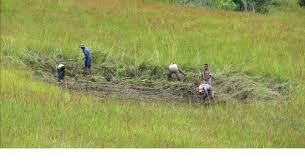
Kilimambogo Hill is undergoing a remarkable transformation thanks to an innovative reforestation approach led by RODI Kenya. Faced with degraded landscapes and declining biodiversity, the organization has adopted foxhole forestry a nature-inspired technique designed to restore ecosystems more efficiently and sustainably.
Unlike conventional tree planting, which often relies on costly seedlings with low survival rates, foxhole forestry uses ten-meter diameter circular plots. These plots are enriched with organic manure and densely sown with a diverse mix of seeds. This method mimics natural forest regeneration, allowing multiple species to grow together and form resilient ecosystems.
The results are already promising. Newly established plots have begun to support vegetation growth, with early signs of ecological recovery such as the re-emergence of water streams and improved local rainfall patterns. This approach not only restores tree cover but also rebuilds entire ecosystems.
The journey has not been without challenges. The process requires intensive physical labor, and teams often navigate difficult terrain, potential wildlife encounters, and occasional land-use conflicts with local grazers. Despite these hurdles, dozens of foxhole plots have been successfully established across the landscape.
Inspired by similar environmental restoration successes in Madagascar, RODI Kenya aims to scale this model across the Nzambani region. The goal is to create a climate-resilient forest system capable of withstanding drought, fires, and shifting weather patterns.
At its core, this initiative is community-driven empowering local people to take an active role in restoring their environment, enhancing biodiversity, and securing long-term ecological and economic benefits.